Friday, August 14, 2015

ESA100

This was a great year for CPEL at ESA!  We had 9 students (2 undergrad, 4 master's, and 3 PhD) in attendance along with 1 junior ecologist (our 1 1/2 year old).  In addition to our own talks and posters(photos below), we saw a lot of great research from students of Nathan Kraft, Debra PetersSteve Archer, Mendy Smith, and many, many others. 

One workshop that was particularly of interest was "Women in Ecology" organized by Andrea Thorpe.  It was very apparent that while there are many great resources for women available, many women are falling through the cracks and in need of support.  I have experienced this myself and seen it happen in other women in ecology.  There is a resource (which I have had difficulty accessing) in the Earth Science Women's Network.  However, we left the workshop with the idea of organizing a network through ESA.  In the meantime, I will be teaching a topic seminar on Women in Ecology and will have weekly blog posts highlighting the challenges and amazing research from a diverse group of women. 

Some memorable quotes from the workshop:
"We can help other women and provide resources by creating a network of women in ecology"

"This is not a male vs. female thing, it's an inclusive thing"

"We don't have a female version of a beard to make us more respected as young female ecologists"

"You don't need to change who you are to be a scientist"

"Have the confidence to represent yourself and what you bring to the table"

"There is no one way; there is no right way; there is what is best for you" (This one has been turned into a haiku from our twitter feed!)

In the short-term, @cpelvcu has created a women in ecology list.  Send us a tweet if you would like to be added.  Hopefully, there will be more to come. 

I almost forgot: our week started off with a unique synergism of ecology and my little pony.  CPEL embraced this and interacted with the Bronies. And now - lots of photos from the conference! 

April explains the functional traits of dune building grasses

Ashley with her poster on functional types and overwash disturbance

Audrey is engaged on the effect of salinity and drought in coastal grasses

Ben explains bistability in barrier islands

Endangered species condoms - don't ask
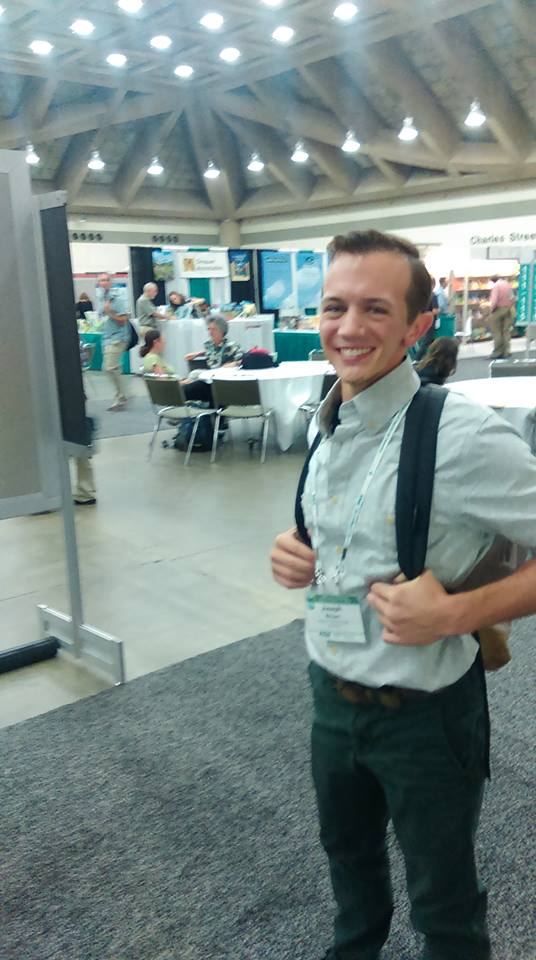
Joe is ready for the poster session

Swag!

Our usual suspects

Young ecologist in training

CPEL-BronyCon Synergism

Why not?

CPEL group photo

 Hog Island - VCR

Saturday, August 8, 2015

Visit us at ESA

If you are attending the Ecological Society of America meeting, come by and visit us  (if you are not, I encourage you to come):
  
Talks:
 
Physiological filters to vegetation establishment on contaminated soil
Tuesday, August 11, 2015: 11:10 AM
347, Baltimore Convention Center
Stephen Via, Julie Zinnert, and Donald Young
 
Linking vines to woody hosts: Untangling the biotic influences in a physically dominated environment
Tuesday, August 11, 2015: 2:50 PM
322, Baltimore Convention Center
Spencer Bissett, Julie Zinnert, and Donald Young
 
Posters:

Grassland species vary in tolerance to stressors associated with climate change
Tuesday, August 11, 2015
Audrey Kirschner and Julie Zinnert
PS 23-22
 
Functional traits explain ecosystem engineering in dune building grasses
Tuesday, August 11, 2015
Julie Zinnert, Joseph Brown, April Harris, Joseph Thompson, and Donald Young
PS 26-52
 
Shrub encroachment and persistence: A case of biofeedback leading to stability after state change
Tuesday, August 11, 2015
Benjamin Dows, Julie Zinnert, and Donald Young
PS 26-66
 
Functional type changes over a disturbance gradient of overwash sites on a Virginia barrier island
Friday, August 14, 2015
Ashley Moulton and Julie Zinnert
PS 88-89

Tuesday, July 28, 2015

Challenges for young ecologists - upcoming Ecological Society of America meeting

One of the most important steps in the professional development of young ecologists is attending ecological meetings, presenting their own research, and most important, developing a network of colleagues. This is important for professional growth and collaborations that lead to synthetic research projects. However, one of the biggest challenges for many young ecologists is the ability to participate in meetings fully. Let me explain.


Graduate students, post-docs, and assistant professors represent the next generation of ecology, but are among the lowest in annual income in the ecological society. Many young ecologists are at the point in their personal life where they are starting families.  With the increase in gender equality and representation of women in the Ecological Society of America (ESA) over the last decade, it is very common to see people (both male and female) with children in tow at the meetings. This has been very inspiring.  Personally, I have taken my children to all but 1 ESA meeting (where I was able to arrange other care with family).


But an overlooked cost of meetings (which are often subsidized by grants and university funds) is child care.  For example, this year a half day of child care at ESA is $45 to $49.50 (depending on time of day).  4 half days of child care at ESA will cost between $180 and $198. 4 full days is $378 (more than I spent on registration).  Due to this high personal cost, many people are faced with different choices: 1) not attending the meeting, 2) couples alternate when they go to meetings, or 3) couples bring their children and make decisions about which session they will attend (this has been our strategy recently).


Fortunately, this topic is receiving increased attention and  some institutions are offering financial support for child care.  The U.S. Office of Management and Budget has new regulations allowing scientists to use federal funds for child care costs. NSF does not allow for reimbursement of child care associated with conferences directly from grants, but the awardee institution may reimburse costs with indirect funds (in the process of finding out VCU's policy). This may help PIs, but likely will not translate to post-docs and graduate students. One possible solution is a modest increase in registration fees to help defray the costs of child care. (I do not know if fees currently are used in this manner).


However, even with financial support, one issue remains; child care is not available when the dinners and discussions that move ecology forward and facilitate networking take place. This requires a change in our attitude about the presence of children in different situations. 

Monday, June 29, 2015

An untouched ecosystem?


As an ecologist, I have always contemplated the question of “Is there an ecosystem that is untouched by mankind?”

 And before I started to do research on Hog Island, VA, I would have answered that question with a resounding “there has to be some nook, cranny, or remote area that remains unaffected.” Now I’m not convinced.

Hog Island, VA is a barrier island off the Atlantic coast of the Delmarva Peninsula that has not been inhabited by humans for quite some time now. So, you might expect that if you visited such a place that you wouldn’t find much evidence of mankind. However, this notion would be wrong.

Map of the Eastern Shore of Virginia
 
 
Aerial photo of Hog Island looking north
As soon as you step foot on this island, it is obvious that as humans we impact all ecosystems, inhabited or not. How this particular ecosystem is impacted by humans is though what I call “sea trash,” which is essentially litter that washes up onto the island.
The amount of sea trash that has washed up over the years on Hog Island is astounding. Anywhere you walk on the island, besides the active beach zone, is pretty much sprinkled with litter. There are your typical plastic bottles from water to Gatorade, there are also your miscellaneously colored glass bottles which most likely previously housed some form of hooch, but there are also things that you might not expect.
The first thing that shocked me were the amount of lightbulbs. THEY ARE EVERYWHERE. From the long four footers that produce the horrible fluorescent lighting in office buildings, to the typical 60 watt bulbs that people use to use in their homes before everyone shifted to the eco-friendly CFL bulbs (you know, the ones that look like a vanilla ice-cream cone swirl), they are all there. It is nothing to be walking through the island interior, which is composed of both grassland and shrub communities, and hear a distinct crunch underfoot knowing good and well that you just accidentally stepped on a lightbulb. The only thing you can do is keep on trekking and try to avoid the next one.
 
Grassland and shrubland communities on Hog Island
The other surprising set of items that seem to wash up fairly regularly are car maintenance items. Air filters are particularly common, as well as oil filters, car oil bottles and antifreeze bottles. Even uninhabited islands can’t seem to escape industrialized, automotive driven America.
Since I visit Hog Island fairly frequently, I have become accustom to the ends and outs of variety of sea trash that washes up, but every now and then you get some particularly interesting items such as old thick televisions half buried in sand, Jumbo LEGO building blocks (yes, even on a remote island your feet are not safe from these monsters), fully inflated beach balls, deflated balloons of all sorts, from Happy Birthday! to Get Well Soon, and buckets galore! Nice buckets too, I’ve even taken a few particularly nice ones home with me!
All of this sea trash however sheds light on another problem that people may not often think about, the cleanliness of our oceans. It is a scary thought that what I see washed up on this island is just a microscopic fraction of what is floating around out there. And with the amount of coastline the world has, it is hard to think of an ecosystem that wouldn’t be impacted by the copious amount of trash floating in our oceans. If you think about it, even Antarctica, one of the most isolated places in the world, has a coastline that could be impacted by sea trash.
This thought and my personal experience on Hog Island is what has firmly solidified my belief that no ecosystem is truly untouched by mankind.
By: April Harris
 

Wednesday, June 24, 2015

A step by step photo guide to completing a field burial experiment

Step 1: build your burial frames

 
Step 2: transport frames to site


 Step 3: put sand in bucket

Step 4: pour sand into frame
 
 
Step 5: repeat for multiple frames until desired sample size in achieved
 
 
Step 6 : get someone else to drive home (photo not shown)


Tuesday, May 5, 2015

Going with the flow or against the grain? The promise of vegetation for protecting beaches, dunes, and barrier islands from erosion.

 Our latest barrier island review article was published in this month's issue of Frontiers in Ecology and the Environment  http://dx.doi.org/10.1890/140218.  As part of the Coastal Barrier Island Network, we worked with an integrative group of coastal scientists including ecologists, engineers, and landscape remote sensing specialists to examine the role of vegetation for protecting coastlines.  Traditionally, coastline protection has been largely engineered to maintain structural stability and protect property.  However, we propose that ecological solutions can be mixed with engineering to create more resilient solutions as storms and sea-level pose threats to coastal stability.  Our article also made the front cover!
 
This summer we will continue with research investigating three dune building grasses: Ammophila breviligulata, Uniola paniculata, and Spartina patens.  Grad students Joe Brown and April Harris spent the last few weeks potting thousands of plants for greenhouse and field experiments.  Through a series of experiments they will determine species responses to salinity, drought, sand burial, and competition.  This work will contribute to our understanding of how different species shape barrier islands in response to climate change. 

 
April and Joe planting for greenhouse experiments.


Planting for field experiments on Hog Island, Virginia.  Winds were >20 mph that day, so we all received a free exfoliation.  The area was cleared of all vegetation prior to planting.  We will simulate overwash on one half of the plots to quantify how individual species respond to sand burial.


Wednesday, February 25, 2015

Stephen Via - PhD candidate

Congratulations to our recent PhD candidate, Stephen Via!  He successfully defended his dissertation proposal titled "From seed to sky: the impacts of explosive compounds on vegetation across scales". Stephen also gave an outstanding presentation to his committee members.  Job well done!
 
A bit about his research: 
The presence of explosive compounds can act as a physiological filter controlling species’ establishment and success in contaminated areas. Explosive compounds in soils have negative effects on vegetation physiological processes, affecting health and survival. The precise impacts of these contaminants vary based on many factors, such as life stage and morphological/physiological tolerances, which are species specific. Many studies have demonstrated species- and individual-level impacts of explosive compounds; however, there is little research investigating multiple explosive simultaneously (such as Composition B). This limits our understanding of impacts in the field and our ability to scale up to community and ecosystem level effects. Thus, a cross-scale approach is needed to reduce speculation.
 
Stephen's project objectives are to: (1) investigate the impacts of explosive compounds on seed germination and plant establishment, (2) investigate the physiological and morphological impacts of explosive compounds on plant species, (3) quantify the impacts of explosive compounds on plant community structure, and (4) detect the presence of explosive compounds via remote sensing of vegetation.